
Turning Construction Technology Into Market Adoption, Pipeline & Growth
About the author: Audri Wadsworth is a marketing executive with more than 15 years of experience at the intersection of construction, AI, SaaS, product innovation and go-to-market strategy. Most recently, she led marketing for a Silicon Valley construction technology startup, managing a $1 million annual marketing budget, an internal marketing team and specialized agency partners across PR, web development, design, advertising and strategic partnerships. Through account-based marketing, product marketing and strategic field marketing, she helped generate qualified enterprise opportunities including a new enterprise account within her first 30 days.
Construction technology is moving quickly.
Owners, contractors and project teams are under increasing pressure to improve productivity, reduce risk, control costs and make better decisions with increasingly complex data. The technology available to them is becoming more sophisticated—but sophisticated technology does not automatically create market adoption.
The companies that win will be the ones that can translate innovation into clear customer value, build trust with the market, and create a go-to-market engine that consistently moves buyers from awareness to action.
That requires more than marketing.
It requires a GTM strategy.
1. Understand the Construction Technology Market
You cannot effectively market construction technology without understanding the industry it serves.
That means looking beyond competitors to understand:
- How contractors, owners and project teams actually work
- Where inefficiencies and risks occur
- Existing technology stacks and integrations
- Emerging AI and automation capabilities
- Competitive positioning
- Strategic partnerships
- Industry trends and regulatory considerations
- Buying committees and adoption barriers
- Where technology creates measurable financial or operational value
The best ConTech marketers aren’t simply translating product features into marketing copy.
They’re translating construction problems into business cases for change.
That requires spending time with customers, sales teams, product leaders and industry experts—and developing enough domain expertise to recognize the difference between what sounds innovative and what actually matters to the buyer.
2. Position the Product Around Business Value
Construction technology buyers don’t purchase innovation for innovation’s sake.
They purchase outcomes.
Does the technology reduce rework? Improve productivity? Increase visibility? Reduce risk? Protect margins? Improve safety? Help teams make faster decisions?
Product positioning should make that connection unmistakable.
Strong positioning answers three questions:
What problem are we solving?
Identify the operational, financial or strategic problem that matters to the customer.
Why is our solution different?
Define the differentiation clearly enough that a buyer can understand why this solution deserves consideration.
Why should the customer act now?
Connect the solution to measurable business impact and the cost of maintaining the status quo.
The objective isn’t simply to make a product sound compelling. It’s to make its value understandable.
3. Create Demand With the Right Message for the Right Buyer
Demand generation becomes significantly more effective when the company knows exactly who it is trying to reach.
That starts with a clear:
ICP → Persona → Problem → Message → Channel → Action
Account-based marketing can be particularly powerful in construction technology because buying decisions often involve multiple stakeholders, long sales cycles and significant implementation considerations.
Content should do more than fill a calendar.
It should:
- Educate the market
- Establish credibility
- Answer objections
- Demonstrate expertise
- Create urgency
- Support sales conversations
- Move prospects through the customer journey
Thought leadership should feel earned—not manufactured.
The strongest ConTech brands have something meaningful to say about the future of the industry because they understand the industry deeply.
4. Meet the Buyer Where Decisions Actually Happen
Construction is a relationship-driven industry.
Digital marketing matters, but so do trade shows, customer meetings, industry associations, networking events, continuing education, demonstrations, partnerships and conversations in the field.
This is where field marketing becomes a strategic growth function—not simply an event-planning function.
A successful field marketing program connects:
Audience → Experience → Conversation → Opportunity → Pipeline
The goal isn’t to collect the most business cards.
It’s to create the right conversations with the right people and give sales a reason to continue the conversation.
Turn Industry Events Into a Relationships & Pipeline Engine
Major industry events offer something that digital advertising cannot completely replicate: concentrated access to the people shaping the industry.
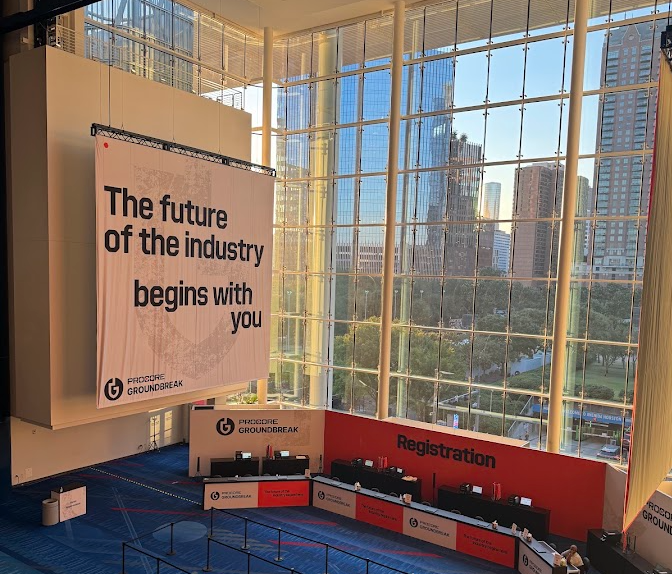
Events such as Procore Groundbreak create opportunities to observe market trends, understand competitor positioning, identify emerging partnerships and build relationships with customers and prospects.
But simply attending isn’t a strategy.
The best event marketers begin before the event:
Before the event
Identify target accounts, partners, speakers, customers and strategic relationships.
During the event
Create intentional experiences that encourage meaningful conversations.
After the event
Follow up quickly, equip sales with context and measure what happened.
At Procore’s Groundbreak event in 2025, I applied this approach by helping create a co-sponsored networking experience designed to connect technology companies, industry professionals and potential customers.
Read the full case study: Field Marketing for Events
The larger lesson is that an event should never exist in isolation from the GTM strategy.
An event is a channel. The experience is the strategy. The relationship is the potential value.
5. Learn to Read the Market—Not Just the Marketing
Construction technology is a competitive market.
Companies are competing for attention, investment, customers, partnerships and category leadership. That creates an enormous amount of content, announcements, awards, events and industry messaging.
For marketing leaders, the challenge is separating signal from noise.
Who is actually gaining market share?
Which products are gaining adoption?
What are customers asking for?
Which partnerships are creating distribution?
What messaging is resonating?
Which competitors are investing heavily—and why?
What is the market saying that the company isn’t hearing?
This is where strong marketing leadership becomes part strategy, part research and part pattern recognition.
The goal isn’t to imitate the companies receiving the most attention. It’s to understand why they’re receiving it—and determine whether that strategy makes sense for your own market position.
AI in Construction: Hype, Opportunity & Responsibility
AI is transforming construction technology, but the rapid adoption of the term “AI” creates another challenge for marketers: credibility.
After working with technology that uses machine learning, language models and project data to automate analysis and surface actionable insights, I’ve seen firsthand how powerful these capabilities can be.
I’ve also seen how easily “AI” can become a marketing label rather than a meaningful explanation of what the technology actually does.
That distinction matters.
Marketing should clarify technology—not exaggerate it.
If a product uses AI to identify patterns in project data, explain what that means for the customer.
If automation eliminates a manual process, quantify the impact.
If a model produces recommendations, explain how those recommendations are generated and where human judgment remains important.
The strongest AI brands will not be the ones making the biggest claims.
They will be the ones customers trust.
Build Credibility Before You Ask for Adoption
Construction technology is ultimately a trust business.
Customers are being asked to change processes, implement new technology, connect systems and sometimes rethink how their teams work.
That requires credibility.
Credibility can be built through:
- Customer evidence and case studies
- Industry research
- Expert thought leadership
- Speaking engagements
- Industry publications
- Strategic partnerships
- Demonstrated product expertise
- Security and compliance standards
- Meaningful participation in industry organizations
- Transparent communication about what the technology can—and cannot—do
Awards and media recognition can support a brand, but they should reinforce real accomplishments rather than substitute for them.
Reputation is built through repeated evidence that a company understands its market and delivers on its promises.
6. Enable Sales, Measure, Optimize. Repeat.
Marketing activity isn’t the same thing as marketing impact.
Pipeline can stall at any point:
Awareness → Engagement → MQL → Meeting → Opportunity → Demo → Proposal → Closed Revenue
A strong GTM organization understands what happens at every stage.
Where are qualified accounts dropping off?
How quickly are leads being contacted?
Which campaigns generate engagement but fail to create opportunities?
Which events generate pipeline?
Which messages improve conversion?
Where is sales struggling to move deals forward?
These questions turn marketing from a cost center into a measurable growth function.
Measure the process. Find the friction. Fix it. Repeat.
Learn more about what I implemented at Slate Technologies in this case study.
The best marketing organizations continuously optimize the system for more successful campaign launches.
The ConTech GTM Advantage
The future of construction will be shaped by companies developing better technology—but technology alone isn’t enough.
The winners will be the companies that can:
Understand the industry.
Identify the right customer.
Position the technology around meaningful outcomes.
Create demand with credibility.
Build relationships in the field.
Enable sales to convert opportunity into revenue.
Use data and AI to continuously improve the system.
That’s the work I do.
I’ve spent 15 years building marketing programs for technology companies, including leading marketing for an AI-powered construction technology company. I’ve managed a $1 million marketing budget, led internal teams and specialized agencies, supported product launches, developed industry partnerships, executed field marketing programs and worked with executive leadership and board stakeholders.
My perspective is simple:
Building the future of construction requires more than innovative technology. It requires a GTM strategy that makes the innovation matter.
That’s where I can make an impact.
Let’s talk about what you’re building, who you’re building it for, and how to turn that innovation into market adoption, pipeline and sustainable growth.
- Product Marketing: positioning, ICP, messaging, customer value
- Field Marketing: events as pipeline/relationship engines
- Demand Gen: ABM, funnel management, conversion
- GTM: connecting marketing to sales and revenue
- ConTech fluency: understanding construction’s unique buying environment
- AI fluency: understanding both the opportunity and the credibility problem
- Executive thinking: budget, prioritization, market intelligence and business outcomes